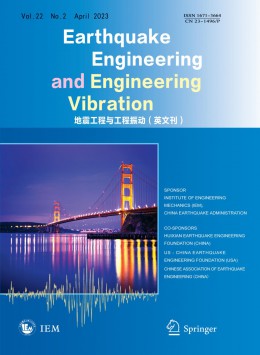
投稿《Earthquake Engineering and Engineering Vibration》需要什么條件?
來源:優(yōu)發(fā)表網(wǎng)整理 2025-12-15 15:06:25 1902人看過
《Earthquake Engineering and Engineering Vibration》雜志是一本在地質(zhì)研究領(lǐng)域具有一定影響力的學(xué)術(shù)期刊,由中國(guó)地震局主管、中國(guó)地震局工程力學(xué)研究所主辦的期刊,創(chuàng)刊于2002年,國(guó)際標(biāo)準(zhǔn)刊號(hào) ISSN:1671-3664,國(guó)內(nèi)統(tǒng)一刊號(hào) CN:23-1496/P。
《Earthquake Engineering and Engineering Vibration》雜志投稿需要滿足以下條件:
Title Page:
The title page should contain: Title, Authors, Affiliations,
Acknowledgement, and Footnotes supplying: Correspondent
author‘s information including: the full name, complete mailing address, telephone and fax number, and, if available, e-mail address; Job titles of all authors; and The name(s) of sponsor(s) of the research contained in the paper, along with grant number(s), if any.
General: The manuscript should be provided in single-spaced typing Time New Roman, 10.5 pt., on A4 size pages in electronic format using Microsoft Word. It must be written in English and should not exceed 13,000 word-equivalents. (A journal page contains approximately 1,300 words.) Technical notes should not exceed 4,000 word-equivalents. If it is necessary to include additional information, such as appendices, these should be submitted electronically for inclusion on a web site for the journal.
Abstracts: Each paper should include an Abstract of 150-200 words, reporting concisely on the purpose of the work, the scope of the effort, the procedures used to execute the work (if of special interest), the major findings, and a list of three to eight keywords. The abstract must be self-contained, and it must not require reference to the paper to be understood.
Text: Follow this order when typing manuscripts: Title, Abstract, Keywords, Main text, Appendix, References, Vitage, Figures (including captions) and then Tables. Footnotes are to be avoided (except for table footnotes). Please complete text minus the title page, acknowledgment, and any running headers with author names, to allow blinded review.
Units: The SI system is to be used throughout; if it is necessary to use other units, these should be added in parentheses.
References
References should appear within the text as the author name(s) followed by the year of publication in parentheses. A list of all references must be given at the end of the text in alphabetical order by last name of first author. Make sure the reference information is complete and accurate, including as necessary and in the following order: last names and initials of all authors; year of publication; title of paper, report or book chapter (in quotes); title of book or periodical (in italic); volume and issue numbers; name and location of publisher (for books), name and location of publisher or sponsor for proceedings), or city of publication (for non-U.S. journals); and inclusive page numbers. The references should be listed in the following style:
Liu Huixian and Zhang Zaiyong (1980), “Lessons Learned from the 1976 Tangshan Earthquake,” Proceedings of the 7th World Conference on Earthquake Engineering, Vol. IX, Istanbul, Turkey, pp.453– 460.
Huo Linsheng and Li Hongnan (2004), “Torsionally Coupled Response Control of Offshore Platform Structures Using Circular Tuned Liquid Column Dampers,” China Ocean Engineering, 18(2):173–183. (in Chinese)
Newmark NM and Rosenblueth E (1971), Fundamentals of Earthquake Engineering, Prentice-Hall, Inc., Englewood Cliffs, N.J.
該雜志旨在推動(dòng)地質(zhì)理論與實(shí)踐的創(chuàng)新與發(fā)展,為廣大地質(zhì)工作者、研究人員提供一個(gè)學(xué)術(shù)交流的平臺(tái),主要是探索地質(zhì)規(guī)律,服務(wù)地質(zhì)實(shí)踐。通過發(fā)表高質(zhì)量的地質(zhì)研究成果,促進(jìn)地質(zhì)領(lǐng)域的學(xué)術(shù)交流與合作,為地質(zhì)改革與發(fā)展提供理論支持和實(shí)踐指導(dǎo)。
影響因子:0.68
發(fā)文量:758
總被引次數(shù):2770
Earthquake Engineering and Engineering Vibration雜志學(xué)術(shù)成果
雜志學(xué)術(shù)成果
Earthquake Engineering and Engineering Vibration雜志年度被引次數(shù)報(bào)告
2010 2011 2012 2013 2014 2015 2016 2017 2018 2019 2020 2021
本刊文章見刊的年份
在2010年的被引次數(shù)
被本刊自己引用的次數(shù)
被引次數(shù)的累積百分比
本刊文章見刊的年份
在2011年的被引次數(shù)
被本刊自己引用的次數(shù)
被引次數(shù)的累積百分比
本刊文章見刊的年份
在2012年的被引次數(shù)
被本刊自己引用的次數(shù)
被引次數(shù)的累積百分比
本刊文章見刊的年份
在2013年的被引次數(shù)
被本刊自己引用的次數(shù)
被引次數(shù)的累積百分比
本刊文章見刊的年份
在2014年的被引次數(shù)
被本刊自己引用的次數(shù)
被引次數(shù)的累積百分比
本刊文章見刊的年份
在2015年的被引次數(shù)
被本刊自己引用的次數(shù)
被引次數(shù)的累積百分比
本刊文章見刊的年份
在2016年的被引次數(shù)
被本刊自己引用的次數(shù)
被引次數(shù)的累積百分比
本刊文章見刊的年份
在2017年的被引次數(shù)
被本刊自己引用的次數(shù)
被引次數(shù)的累積百分比
本刊文章見刊的年份
在2018年的被引次數(shù)
被本刊自己引用的次數(shù)
被引次數(shù)的累積百分比
本刊文章見刊的年份
在2019年的被引次數(shù)
被本刊自己引用的次數(shù)
被引次數(shù)的累積百分比
本刊文章見刊的年份
在2020年的被引次數(shù)
被本刊自己引用的次數(shù)
被引次數(shù)的累積百分比
本刊文章見刊的年份
在2021年的被引次數(shù)
被本刊自己引用的次數(shù)
被引次數(shù)的累積百分比
聲明:以上內(nèi)容來源于互聯(lián)網(wǎng)公開資料,如有不準(zhǔn)確之處,請(qǐng)聯(lián)系我們進(jìn)行修改。